CANSEE/SCANÉÉ 2026: Planes, trains, and abstract deadline extensions
La version française suit.
Hello CANSEE/SCANÉÉ Community!
We’ve extended the deadline for abstract submissions for paper presentations and lightning talks until June 15, 2026. It is not too late! Get your abstract submission in!
If you know of like minded groups, listservs or networks that would be interested in attending our little gathering, please help spread the word by sharing our abstract call!
Early Bird Registration
Early bird rates are available now for Changing Tides, taking place October 7–9, 2026, at the Membertou Trade & Convention Centre in Sydney, Cape Breton. The conference is hosted by Cape Breton University and the Shannon School of Business.
Register:https://event.fourwaves.com/cansee2026/pages/b29b9f3c-fd37-4805-a2b8-d3861c508934
Conference info: https://event.fourwaves.com/cansee2026/pages
A note on timing for those of you getting your transportation and accommodations sorted out early: conference programming begins at start of day on the 7th and ends at the end of day on the 9th, so plan on arriving the 6th and leaving on the 10th for the whole CANSEE/SCANÉÉ experience.
Getting to the Conference
Planes, Trains, and Automobiles: Rethinking “Eco-Friendly” Travel

Source: https://people.com/steve-martin-was-weeping-with-john-candy-in-planes-trains-scene-8622006
An important question when travelling for conferences is how to minimize our contributions to human-induced climate change. Of course, the simplest answer would be to not travel at all, but we are a social species that thrives on personal connection. For simplicity, consider three modes: plane, train, and automobile. What is the best way to make a long-distance trip in Canada? We must make the further assumption that train travel is a viable option. We can use life cycle assessment (LCA) methods to make this comparison. Before getting to the results, bear in mind–as LCA professor Joule Bergerson always said– “the answer depends.”
Via Rail promotes the train as the “most eco-friendly way to travel”. Their statement is certainly biased by the fact they are the train provider, but it is supported by IEA analysis. Importantly to judging impacts, IEA estimates do not include non-CO2 climate-forcing impacts for aviation (i.e., high-altitude nitrogen oxides, water vapor, and contrail formation), which Lee et al. (2021) estimate contribute 2.1x the CO2-only value. Thus, aviation emissions in the IEA figure should be tripled from their reported values, shifting the impact well above the upper range of large cars.
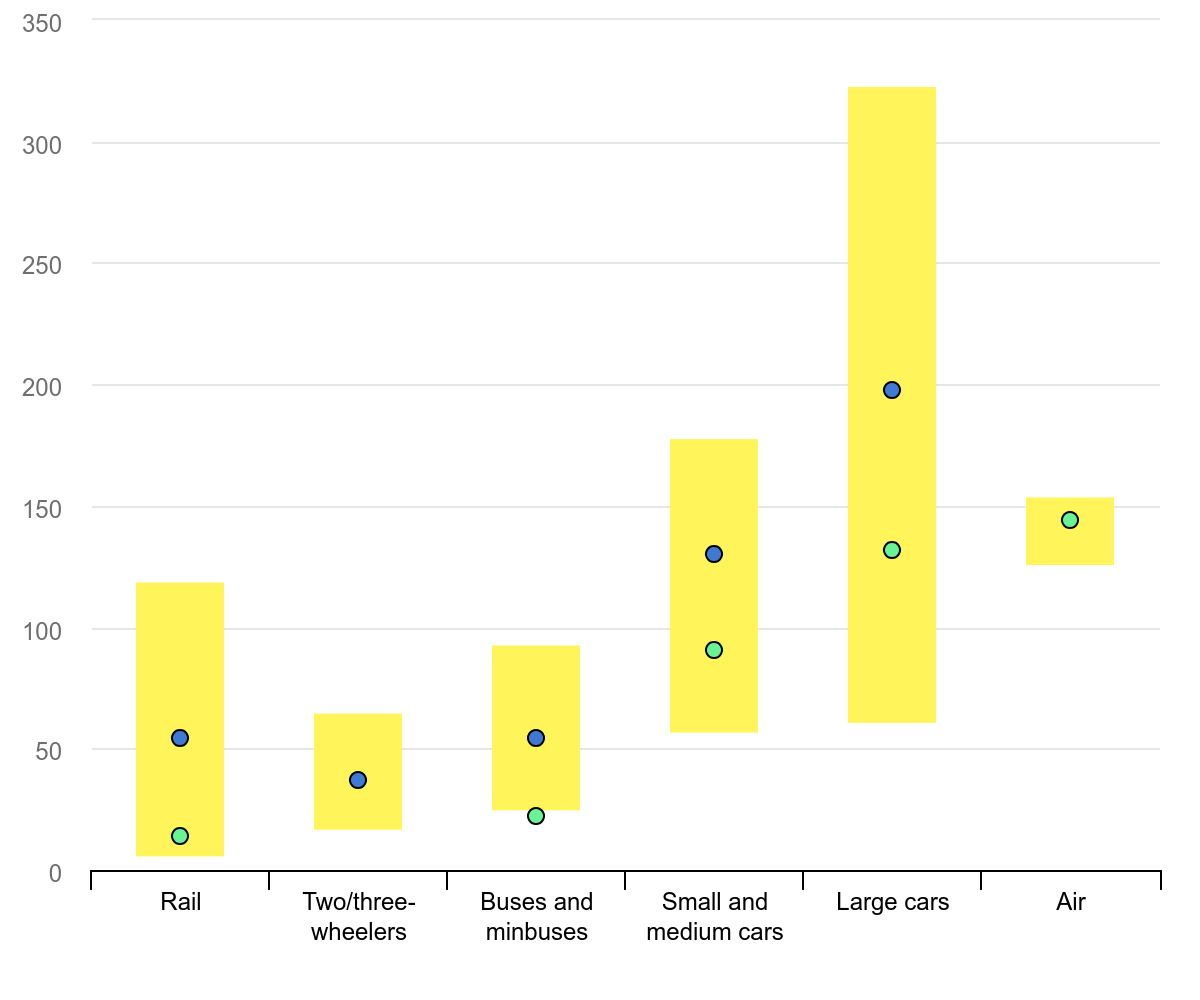

Estimates of gCO2-eq/pkm by Travel Mode with Intensity Ranges
Source: https://www.iea.org/data-and-statistics/charts/ghg-intensity-of-passenger-transport-modes-2019
However, one study cited in a 2022 CBC News article titled “Why the train may not be the greenest way to travel across Canada”, finds that train travel on the Windsor-Quebec City corridor is only marginally better than flying. The author finds that low passenger occupancy and the use of diesel locomotives leads to emissions factors above international benchmarks. It is also found that the Montreal-Halifax route generates much higher emissions than an equivalent flight. It should be noted that Via Rail has since upgraded their fleet to more efficient diesel engines and with the ability to convert the fleet to diesel-electric.
Alex Bigazzi of UBC provides robust and reliable LCA results for Canada. First, note that Bigazzi distinguishes between average and marginal emissions factors. You can think of an average factor as distributing emissions across current passenger travel (pass-km). Marginal emissions factors differ in that they focus on how an additional traveller affects pass-km vs. vehicle-km. An additional private vehicle traveller will likely be alone in their vehicle, so their pass-km = new veh-km. In contrast, a new train passenger is just filling another seat on a train that is already travelling the corridor - no additional veh-km! Air travel is somewhere in-between the two, generating more marginal veh-km than trains but not as much as private vehicles. To use economic terms, intercity rail has an elasticity of vehicle km travelled (VKT) to passenger km travelled (PKT) of 0.27 (2.7% more VKT for a 10% increase in PKT), whereas air travel has an elasticity of 0.65 (6.5% more VKT for a 10% increase in PKT). Using data as of 2018 for Canada, Bigazzi finds the average emissions factor (kg per PKT) for rail is 10% lower than air travel and 30% lower than private vehicle. The big change comes when we consider results from a marginal emissions perspective: 60% and 80% lower than air and private vehicle, respectively (references available at end of newsletter).
Renew Your Membership
A regular reminder: if you have not renewed your membership recently, or are thinking about joining CANSEE/SCANÉÉ, please do. Your membership supports our 2026 conference planning and gives you the power to vote in our upcoming 2026 election.
CANSEE membership is held through the International Society for Ecological Economics (ISEE).When becoming an ISEE member, you can designate CANSEE/SCANÉÉ as your home regional society. Any ISEE member is eligible for the conference member rate, so we encourage you to join the society before registering.
Renew or join: isecoeco.org/membership
In Solidarity and Care,
Your CANSEE/SCANÉÉ Board

Bonjour à la communauté CANSEE/SCANÉÉ!
Nous avons prolongé la date limite de soumission des résumés pour les présentations de communications et les exposés éclair jusqu’au 15 juin 2026. Il n’est pas trop tard ! Envoyez-nous votre résumé sans tarder !
Soumettre un résumé : https://event.fourwaves.com/cansee2026/pages/457f9ed8-f083-41a2-8d40-023fff8e4a75
L'inscription hâtive est ouverte
Les tarifs d'inscription hâtive sont disponibles dès maintenant pour Vagues de Changement, qui se tiendra du 7 au 9 octobre 2026, au Membertou Trade & Convention Centre à Sydney, au Cap-Breton. La conférence est organisée par l'Université du Cap-Breton et la Shannon School of Business.
Inscription : https://event.fourwaves.com/cansee2026/pages/b29b9f3c-fd37-4805-a2b8-d3861c508934
Une petite précision concernant les dates pour ceux d'entre vous qui s'occupent à l'avance de leur transport et de leur hébergement : le programme de la conférence commence le matin du 7 et se termine le soir du 9 ; prévoyez donc d'arriver le 6 et de repartir le 10 pour profiter pleinement de l'expérience CANSEE/SCANÉÉ.
Informations sur la conférence : https://event.fourwaves.com/cansee2026/pages
Se rendre à la conférence
Avions, trains et voitures : repenser les déplacements « écologiques »
Une question importante lorsqu’on se déplace pour assister à des conférences est de savoir comment réduire au minimum notre contribution au changement climatique d’origine humaine. Bien sûr, la réponse la plus simple serait de ne pas voyager du tout, mais nous sommes une espèce sociale qui se nourrit des liens humains. Pour simplifier, considérons trois modes de transport : l’avion, le train et l’automobile. Quel est le meilleur moyen d’effectuer un trajet longue distance au Canada ? Nous devons partir de l’hypothèse (malheureusement forte) que le train est une option viable. Nous pouvons utiliser les méthodes d’analyse du cycle de vie (ACV) pour effectuer cette comparaison. Avant d’aborder les résultats, gardez à l’esprit – comme le disait toujours le professeur Joule Bergerson, spécialiste de l’ACV – que « la réponse dépend ».
Via Rail présente le train comme « le moyen de transport le plus écologique ». Leur affirmation est certes biaisée par le fait qu’ils sont le fournisseur de services ferroviaires, mais elle est étayée par l’analyse de l’AIE. Il est important de noter, pour évaluer les impacts, que les estimations de l’AIE n’incluent pas les impacts climatiques non liés au CO₂ de l’aviation (c’est-à-dire les oxydes d’azote à haute altitude, la vapeur d’eau et la formation de traînées de condensation), qui, selon Lee et al. (2021), contribueraient à hauteur de 2,1 fois la valeur du CO₂ seul. Ainsi, les émissions de l’aviation dans les chiffres de l’AIE devraient être multipliées par trois par rapport aux valeurs rapportées, ce qui placerait leur impact bien au-dessus de la fourchette supérieure des grosses voitures.
However, one study cited in a 2022 CBC News article titled “Why the train may not be the greenest way to travel across Canada”, finds that train travel on the Windsor-Quebec City corridor is only marginally better than flying. The author finds that low passenger occupancy and the use of diesel locomotives leads to emissions factors above international benchmarks. It is also found that the Montreal-Halifax route generates much higher emissions than an equivalent flight. It should be noted that Via Rail has since upgraded their fleet to more efficient diesel engines and with the ability to convert the fleet to diesel-electric.
Alex Bigazzi of UBC provides robust and reliable LCA results for Canada. First, note that Bigazzi distinguishes between average and marginal emissions factors. You can think of an average factor as distributing emissions across current passenger travel (pass-km). Marginal emissions factors differ in that they focus on how an additional traveller affects pass-km vs. vehicle-km. An additional private vehicle traveller will likely be alone in their vehicle, so their pass-km = new veh-km. In contrast, a new train passenger is just filling another seat on a train that is already travelling the corridor - no additional veh-km! Air travel is somewhere in-between the two, generating more marginal veh-km than trains but not as much as private vehicles. To use economic terms, intercity rail has an elasticity of vehicle km travelled (VKT) to passenger km travelled (PKT) of 0.27 (2.7% more VKT for a 10% increase in PKT), whereas air travel has an elasticity of 0.65 (6.5% more VKT for a 10% increase in PKT). Using data as of 2018 for Canada, Bigazzi finds the average emissions factor (kg per PKT) for rail is 10% lower than air travel and 30% lower than private vehicle. The big change comes when we consider results from a marginal emissions perspective: 60% and 80% lower than air and private vehicle, respectively (references available at end of newsletter).
Renouvelez votre adhésion
Un rappel régulier : si vous n'avez pas renouvelé votre adhésion récemment ou si vous songez à devenir membre de la CANSEE/SCANÉÉ, n'hésitez pas. Votre adhésion soutient la planification de notre conférence 2026 et vous donne le droit de voter lors de nos prochaines élections.
L'adhésion à la CANSEE se fait par l'entremise de la Société internationale d'économie écologique (ISEE). En devenant membre de l'ISEE, vous pouvez désigner la CANSEE/SCANÉÉ comme votre société régionale d'appartenance. Tout membre de l'ISEE peut bénéficier du tarif pour membre en vue de la conférence. Nous vous encourageons donc à adhérer à la société avant de vous inscrire.
Renouveler ou adhérer : isecoeco.org/membership
Avec solidarité et bienveillance,
Votre conseil d'administration de CANSEE/SCANÉÉ
References:
- https://corpo.viarail.ca/en/projects-infrastructure/train-fleet/fleet-replacement-program
- Katz‐Rosene, R. M. (2021). A not‐so‐green choice? The high carbon footprint of long‐distance passenger rail travel in Canada. The Canadian Geographer/Le Géographe Canadien, 65(2), 141-151.
- Bigazzi, A. (2019). Comparison of marginal and average emission factors for passenger transportation modes. Applied Energy, 242, 1460-1466.
- Lee, D. S., Fahey, D. W., Skowron, A., Allen, M. R., Burkhardt, U., Chen, Q., ... & Wilcox, L. J. (2021). The contribution of global aviation to anthropogenic climate forcing for 2000 to 2018. Atmospheric environment, 244, 117834.